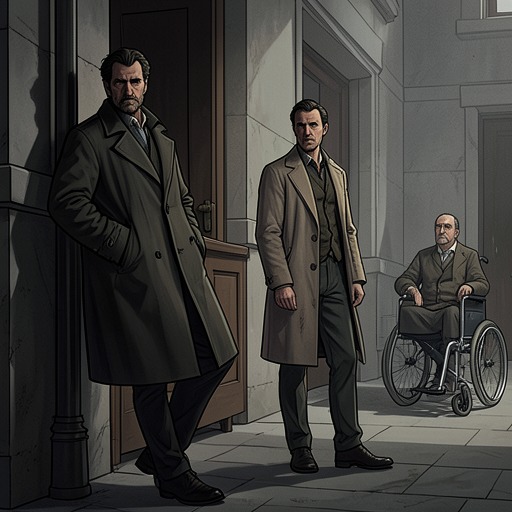
Steelcor furnace accident
American RustThe Steelcor furnace accident killed Chuck Cunningham and Wayne Davis and left Henry English alive after he jumped from the shop during the emergency. Recalled years later amid Henry’s thoughts about his family and his own responsibility, the accident is more than a workplace catastrophe: it links industrial cost-cutting to the sudden loss of workers’ lives, while Henry’s survival becomes entangled with regret over what he believes he failed to provide for those closest to him.
Background and Industrial Context
Henry had spent three years commuting from Indiana to work at Steelcor, returning home only about once a month. The job paid well, but he remembered it as demanding and unsafe. He had initially accepted the argument that labor costs and unions were to blame for industrial trouble; with hindsight, he came to see that explanation as incomplete. His recollection sets the accident against a larger history of mills allowed to deteriorate while companies pursued production and profit.
Henry’s account also distinguishes that broader history from the specific failure at Steelcor. He recalled Penn Steel and other American mills going years without investment, while German and Japanese producers continued upgrading their plants. Those comparisons shape his retrospective understanding of industrial decline: the loss of steel work was not simply the inevitable consequence of wages or workers’ expectations, but also reflected decisions about whether to maintain and renew industrial infrastructure. The accident gives that structural criticism immediate human stakes, though the text does not establish that Penn Steel’s investment history directly caused the Steelcor failure.
The Accident
The accident began during a pour. A crane was carrying a ladle containing fifty tons of liquid steel when Henry heard an unfamiliar sound. The crane continued to swing, but the ladle wobbled and fell. Its load spilled across the shop, killing Chuck Cunningham and Wayne Davis, while Henry was close enough to understand that he might not survive.
The failure was not presented as an unforeseeable mischance alone. Henry’s recollection identifies a safety brake on the hoisting drum as necessary equipment and says it was absent because the company had been too cheap to provide it. A gearbox component sheared, allowing the ladle to fall. In the sequence of his memory, the broken mechanism and the missing safeguard make the disaster legible as a preventable industrial failure, even as its suddenness left Henry feeling powerless within it.
As the shop caught fire and further hazards made remaining inside impossible, Henry jumped from three stories. A young Black worker went back through the fire and dragged him out; the rescuer had not been injured. Henry later recalled that the young man said he had seen him jump. The episode therefore turns on a stark reversal: Henry escaped a scene in which two of his coworkers died, but his survival depended on someone else choosing to return for him.
Deaths, Survival, and Aftermath
The company’s regulatory penalty sharpened Henry’s sense of the imbalance between the loss and its cost to the employer. OSHA fined the company thirty thousand dollars, an amount Henry understood to equal what it made in a single minute. The fine did not restore the two workers’ lives; in his recollection, its scale becomes evidence of how little the formal consequence seemed to match the human cost.
Henry also returned to the accident through a painful calculation about survival. He wondered whether jumping had been a mistake, imagining that if he had remained where he was, his family might have received a pension and compensation from the company. He contrasted his own escape with the deaths of Chuck and Wayne, whom he thought of as having secured their families’ futures. This is Henry’s anguished retrospective judgment, not evidence that either family actually received a particular payment. Its force lies in the way survival fails to feel like uncomplicated good fortune: he measures it against the support he believes he did not leave behind.
Narrative Function and Significance
The accident returns in a fragmented recollection as Henry drifts from present concerns into memories of the mill. That shift makes the event’s consequences psychological as well as occupational. The failed brake and sheared gearbox recall a concrete workplace disaster; Henry’s later thoughts attach it to his broader sense of failure as a husband and father. His memory does not offer a clean moral accounting. It holds together the company’s responsibility for unsafe equipment, the deaths of two workers, the rescue that saved Henry, and his own troubled belief that surviving may have cost his family something.
The episode also connects an individual catastrophe to the Valley’s shrinking industrial world. Elsewhere, the narrative describes the region’s vast job losses, strained public services, and families left with few local opportunities. Against that background, Steelcor’s accident is not a complete explanation for the Valley’s decline, but a concentrated instance of its human stakes: industrial work could sustain a household and also expose workers to dangers shaped by decisions beyond their control. The memory’s unresolved burden follows Henry into the present, where thoughts of his children and of what he has caused make the accident part of his continuing reckoning rather than a closed chapter.